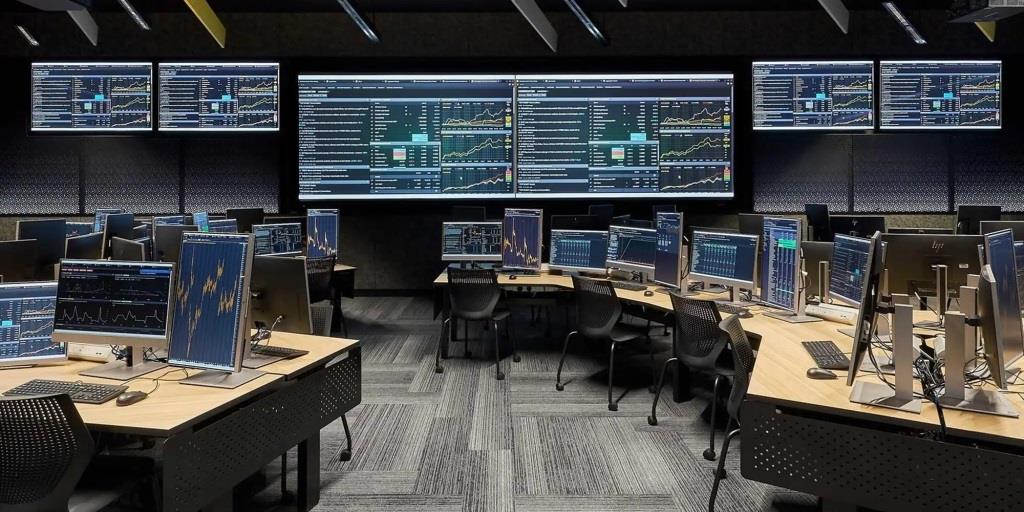
The appeal of low latency trading which is the execution of strategies to make profits from tiny price fluctuations or a fleeting loss of efficiency measured in microseconds - is a powerful. The issue for the fund-funded trader within a prop company isn't only about the profitability but also its feasibility and compatibility with the retail-oriented prop model. The firms don't provide infrastructure. Instead they focus on accessibility and risk-management. The process of grafting a low-latency operation onto this foundation requires navigating through a myriad of technical limitations, rules-based bans and misalignments in the economy that can make the venture not just difficult, but counterproductive. This study reveals the ten realities that separate high frequency prop trading from its actual practice. The majority of people find the effort is in vain and for the handful that succeed the approach must be totally rethought.
1. The Infrastructure Gap – Retail Cloud vs. Institutional Colocation
To reduce the latency of your network (travel time) it is necessary to physically co-locate your servers within the center of data for the matching engine. Proprietary companies offer access to brokers' cloud servers. They usually are located in general retail-focused cloud hubs. Orders are sent from the home, via the prop firm's server, to the broker's, and eventually to the exchange. The route is filled with unpredictability. This infrastructure is not designed for speed, but rather it is designed to be reliable and affordable. This latency (often between 50-300ms round-trip) is a long time when as compared to lower-latency. This ensures that you're always in the middle of the line fulfilling orders after the institutional players have taken the lead.
2. The Rule Based Kill Switch No-AI, "Fair Usage", and HFT Clauses
Buried in the terms of Service of virtually every retail prop company are explicit bans on High-Frequency Trading (HFT) or arbitrage, and frequently "artificial intelligence" or any other form of automated utilization of latency. These strategies are referred to as "abusive", or "nondirectional". This type of activity is detected by firms through order-to trade ratios and cancellation patterns. Violations of these clauses can cause immediate account closing and forfeiture profits. These rules exist because these strategies can result in significant exchange fees to the broker, while not producing predictable revenue from spreads that the prop model is based on.
3. The Economic Model Missalignment: The Prop Firm is not your partner.
Prop firms usually take the percentage of their profits to determine their revenue model. If a low-latency strategy, if it is successful it will yield small profit margins that correspond to high turnover. The company's fixed costs (data fees platforms, data fees, and support) don't change. They would prefer to have a trader who earns 10 percent per month from 20 trades than one who earns 22% per week on more than 2,000 trades since their administrative and cost burdens are similar. Your results measures, which are small victories that are often occurring, do not match their profitability-per-trade performance metrics.
4. The "Latency arbitrage" illusion and also being the Liquidity
Many traders believe they are able to perform latency arbitration between different brokers or assets in the same company. It is a misunderstanding. The feed of the firm is usually an unconsolidated and somewhat delayed feed from either a single provider of liquidity or from their own internal risk book. It is not possible to trade a feed directly from the market; instead, you trade against a quoted price. Arbitrage of the feed of their own is not possible as is trying to arbitrage between two prop companies creates more abysmal latency. Your low-latency order becomes liquid and free to the company's risk engine.
5. Redefinition "Scalping", Maximizing the Possibilities and not Believing in the Impossible
What is often possible in a prop-context is reduced-latency-disciplined scalping. This requires using the VPS (Virtual Private Server) situated geographically near to the broker's trade server in order to shave off inconsistent home internet lag, aiming for execution between 100 and 500ms. It's not about beating the market but about having a reliable, predictable strategy to take a short-term (1-5 minutes) direction. The competitive edge comes from your market analysis and managing risk, not the microseconds of speed.
6. The Hidden Costs Architecture: Data Feeds, VPS Overhead
You'll require professional-grade data to try trading with a lower latency (e.g. order book data L2 as opposed to candles), and a powerful VPS. These costs are generally not covered by the prop firm and can be a monthly cost of between $200-$500. Before you can begin to see any personal profit from your strategy, the edge must be large enough to cover all of the fixed costs.
7. The drawdown rule and the Consistency Rule problem
Low-latency or high-frequency strategies often have high winning rates (e.g., 70 percent or more) but they also face often small, but frequent losses. This could result in an eventual scenario of "death from a hundred cuts" in the daily drawdown rules. Strategies can make money at the end of the day but an accumulation of 10 consecutive losses under 0.1 percent within an hour could be in violation of the daily limit of 5%, which would result in the account being shut. The strategy's intraday volatility pattern is in complete opposition to the blunt limit on daily drawdowns that are designed for swing trading with slower types.
8. The Capacity Restraint: A Strategy profit ceiling
Strategies that are truly low latency have a very high capacity limit. Their edge will disappear if they trade more than an amount. If you were to create a successful strategy using a $100K prop and your profit are very small in terms of dollars. This is due to the fact that it is impossible to increase the size of your account and not lose the advantages. Prop firms could not grow the account up to $1 million therefore the experiment is insignificant.
9. It's impossible to win the race to be the best in technology
Low-latency is a technology arms-race that costs millions of dollars, and requires custom hardware like FPGAs, microwave networks and kernel bypass. Retail prop traders are competing against firms that have more IT budgets than all the traders of a prop company together. The "edge" is only temporary and the result of a more effective VPS. You are bringing a knife to a thermonuclear war.
10. The Strategic Pivot: Using low-latency tools to implement High-Probability
A total strategic pivot is the only way that will work. Use the tools of the low-latency world (fast VPS, quality data, efficient code) not to chase micro-inefficiencies, but to execute a fundamentally sound, medium-frequency strategy with supreme precision. In order to achieve the best possible entry timings on breakouts, it is important to use Level II data, have stop-loss and take-profits that react immediately to stop slippage and automate a swing trading system to automatically open when specific conditions are met. Here, technology is used to maximise the use of an edge derived from market structure or momentum, and not to generate the edge itself. This aligns to prop strict rules and concentrates on meaningful profits targets. It also turns the disadvantage of technology into a long-lasting, real benefit in execution. View the top https://brightfunded.com/ for site info including best futures prop firms, top trading, prop trading, site trader, earn 2 trade, topstep funded account, futures trader, funding pips, my funded forex, trading evaluation and more.

From Funded Trader To The Trading Mentor: Career Pathways Within The Prop Trading Ecosystem
The road to becoming a profitable and well-funded trader in an organization that provides proprietary services often reaches critical factors: scaling up by more money comes with physical and strategy limits, and the pursuit alone of pips is losing appeal. At this point, that the most successful investors think beyond P&L, and how they can turn their experience gained through hard work into a brand new asset -- their intellectual capital. To transition from a funded trading company to one that is a mentor it's not just about teaching. It's also about learning how to improve your method and establish a brand and establish income streams that don't depend on market performance. However, this path is plagued with ethical, strategic, and commercial dangers. It is crucial to shift from a performance-based private job to one that is a public education position. You will also need to deal with the uncertainty of a crowded market and alter your approach to trading from an income source to an evidence of concept. This shift signifies the change from an experienced practitioner to a viable business in the broader trading eco-system.
1. The Essential Prerequisite: A Verifiable Long-Term Track Record, as Credibility Currency
Before you offer any advice, it is important to have a proven track of record. It's the only way to earn trustworthiness that you should not compromise on. In an industry that is filled with fake screenshots and even hypothetical returns, for the vast majority of the time authenticity is an uncommon resource. It's important that you have access to auditable dashboards (with all personally identifiable information removed) with consistent payments from minimum 18-24 months. The course of your career including all of its documented losses, drawdowns as well as successes and failures, is far more valuable than a winning streak. Mentorship is not based on the myth of perfectionism rather, it is the demonstration of how to navigate through the world of real life.
2. The Productization Challenge: How do you turn into Tacit Knowledge into a Course that sells
Trading edge is a sense about the market which has been refined through experience. Mentorship requires the transformation of the tacit knowledge, a sense for the market honed through experience, into clear and structured knowledge that can be an easily sellable course. This is called "productization". It is necessary to dismantle the entire structure of your operation including your market entry trigger criteria and management guidelines for real-time risk, as well as your journaling of psychological aspects. It becomes a reproducible and step-by-step method. The goal isn't "making your students rich" but rather providing a clear and logical framework for decision-making under uncertainty.
3. The distinction between Signal-Selling, Account Management and Education The Ethics Imperative
As soon as the path of a mentor is divergent it is a fork in the road. The low-integrity route includes selling trading signals and managed account services. This can lead to legal liability and unbalanced incentives. The route with the highest integrity is teaching in the form of classes where students are taught how to build their own personal strengths and how they can successfully pass prop-firm tests. Your earnings must always come from the structured coaching program, access to community and training. Never from their profits or managing their capital directly. This clean separation preserves credibility and makes sure that rewards are based solely on their education results.
4. Niche specialization: Controlling of a particular area of the prop universe
You cannot become an "all-purpose trading mentor." The market is saturated. You have to be able to identify a hyper specific niche within the Prop ecosystem. Examples include: "The 30-Day Evaluation Sprint Mentor for Index Futures," "The Psychology-First Coach for Traders Stuck in Phase 2," or "The Algorithmic Scripting Mentor for MetaTrader 5 Prop Traders." This area will be defined by either a certain instrument or phase of the prop's journey. The ability to specialize makes you the preferred expert to people with a high level of intent and a targeted target audience. It also allows for the creation of content that is both relevant and is not generic.
5. Dual identity management: Trader vs. Educator Mindset Conflict
As an educator, you carry a dual identity. You're both the trader who is doing the executing, and the explainer. Both perspectives have the potential to be at odds. The brain of traders is intuitive, quick and comfortable with uncertainty. The brain of an educator must be analytical, patient and able to create clarity from the complexity. You risk losing the performance of your trading due to the amount of time and mental strain that mentoring demands. You must establish strict boundaries. You must create "trading time" during times when you are not on-line and "teaching times" to help your mentorship. Your trading activities must be safeguarded and kept confidential like you would the R&D facility for your education material.
6. The Conceptual Proof of Concept Continuum The Trading Continuum as a Case Study
You should not share the live calls you make. But your performance as a fund-funded investor can serve as an ongoing, live proof of concept for your strategy for trading. This does not mean that you should share every single success. However, you must periodically share lessons that you have learned through your trading. It shows that your lessons don't only exist in the abstract, but that they are utilized and supported in the real world. This transforms your private trading into the final validation of the educational value of your product.
7. The Business Model Architecture: Diversifying Revenue beyond Coaching Hours
Relying only on 1-on-1 coaching is a time-for-money trap that doesn't scale. Professional mentoring businesses require an organized structure of revenue that has multiple levels:
Lead Magnet: A free guide or a webinar that addresses the most pressing issue in your field.
Core Product : A video tutorial or manual which explains the system in detail.
High-Touch Services: A high-quality group coaching cohort or a specialized mastermind.
Community SaaS (Software as an Service) A recurring fee for an exclusive forum that provides updates and continuous Q&A.
This model is a good value proposition in a range of price points. It also builds a more sustainable business that is not dependent on everyday involvement.
8. The Content as A Lead Generator Engine: demonstrating Your Value Before Selling
Mentorship in the digital age is sold by demonstrating the ability. Produce high-quality, targeted content. Write deep dive posts (like this) or create YouTube videos that analyze the market's setups using your method, and host Twitter/X topics exploring the psychology behind trading. The content you create isn't ad-hoc, but genuinely helpful. It acts as a perpetual lead generation engine, drawing students who have received benefit from your advice and trust in your expertise before any financial transaction occurs.
9. Legal and Compliance Minefield. Disclaimers and managing expectations
It is unlawful to provide educational courses on trading. Get a legal professional to develop declarations that clearly state that past performance is no indicator of the future. Also, make it clear that you're not a financial adviser. And that trading involves the possibility of loss. It is essential to clearly declare that you don't guarantee students will pass exams or earn money. The contracts you sign must clearly state the service you provide is restricted to educational purposes. This legal framework is not only to safeguard, but it's also essential to ethically control expectations of students.
10. The ultimate goal - building Assets that are beyond Market Exposure
This will let you have a steady income even when the market is down or your trading strategy is becoming less effective. The diversity of your work can create a huge psychological stability. At the end of the day, you're building an image, a knowledge asset, as well as a business which can be licensed or expanded without regard to your time on the screen. This is the change from the trading capital offered by an organisation to building your own intellectual capital, the most valuable asset in the knowledge-based economy.